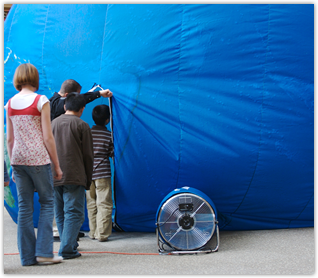


Earth
Balloon®
The following is one of many topics covered during an Earth Balloon visit.
Rain forests: Important ecological areas
being affected by man.
What is a rain forest?
Tropical rain forests receive a minimum of 80 inches and as much as 200-300
inches of rain each year. Tropical rain forests must have a temperature range
of 70-80 degrees year round.
Where are rain forests found?
The four major geographic regions in which tropical rain forests are found:
(all are near the equator)
-
South and Central America
-
Africa and Madagascar
-
South and Southeast Asia
-
New Guinea and Australia
Each of these forest areas is separated by thousands of miles and are all
unique.
Why are rain forests important to us?
-
2/3 of all of the world's plant and animal species live only in the tropics.
Loss of tropical rainforest is the leading cause of species extinction globally.
-
40% of all prescriptions written in the US today contain at least one ingredient
originally made from a plant from these regions. These fight such diseases
such as cancer, leukemia, muscular and heart diseases.
-
Industry has benefited from rain forests: rubber, resins for paints, oils,
waxes, soaps and plastics.
-
Agriculture has benefited from rain forests: Tea, coffee, bananas, oranges,
lemons, peanuts, pineapples, etc. originally came from these regions.
-
Rain forests serves as the earth's lungs, producing the oxygen we breathe
and removing C02 from the atmosphere.
What is happening to the rain forests?
-
Deforestation: the clearing and burning of forests.
Each year more than 1000 types of plants and animals are destroyed by
deforestation.
-
Over 40% of the earth's rain forests have been destroyed. It takes hundreds
of years for a rain forest to reach peak maturity.
-
Rain forests have are being destroyed 40% faster today than 10 years ago.
-
1/2 of the African rain forest is gone.
-
2/3 of the tropical rain forests in India have been destroyed.
-
At current rates of deforestation, all tropical forests in the Philippines
and Madagascar will be destroyed within 20 years.
-
Every year 78 million acres of rain forest are completely destroyed. (32
inches square on the Earth Balloon - an area the size of Poland).
-
Brazilian rainforests are being destroyed at a rate of 13,000 acres per day,
about 8 football fields per minute. The burning of rain forests increased
28% between 1996 and 1997. If deforestation were to continue at the present
rate, 80-90% of tropical rainforest on earth will be destroyed by the year
2020.
Why are the rain forests disappearing?
-
200 million people live in rain forests.
-
Farmland: Slash and burn method. The soil is not suited to farming and will
support crops for only a few years.
-
Lumber: Valuable wood; teak mahogany used to build furniture. Lower quality
wood used to make plywood and fiberboard. Modern machinery can cut down forested
land at an alarming rate.
-
Firewood: native people use the wood for fuel. i.e.: Haiti, Madagascar, India.
Too many people - too little money.
How can we halt the destruction?
-
Change current method of agriculture. Palm trees actually help the soil in
rain forests. They bring nutrients into the soil and thrive on the nutrient
week soil of the rain forests. These palm trees help stabilize the soil and
thus prevent erosion while palm oil provides a useful source of income.
-
Change the current methods of harvesting timber. Selective logging vs. clear-cut
logging allows forests to heal themselves naturally. Ideally logging in rain
forests needs to be halted completely to ensure the safety of rain forests.
Currently the US imports 2% of it's lumber from tropical sources.
-
Groups and governments are buying large tracts of rainforest to keep as reserve
areas that can't be destroyed.
-
Recycle and buy materials made from post consumer waste.
-
Learn about what is happening to the rain forests. You can help by talking
to your friends and relatives about the destruction of the rain forests.
There are many international organizations set up to protect natural resources
such as the rain forests. You could contact them and support them in their
work of protecting the rain forests.
-
Don't purchase products made of rare woods, such as mahogany, that are not
sustainable harvested.
-
Revised: June 7, 2001
copyright © 2000, Earth Balloon, Inc.